Borrow, Rent or Buy a Tool for One Job?
Borrow, rent or buy a tool for one job by weighing access, storage, repeat use and coordination before choosing the least troublesome option.
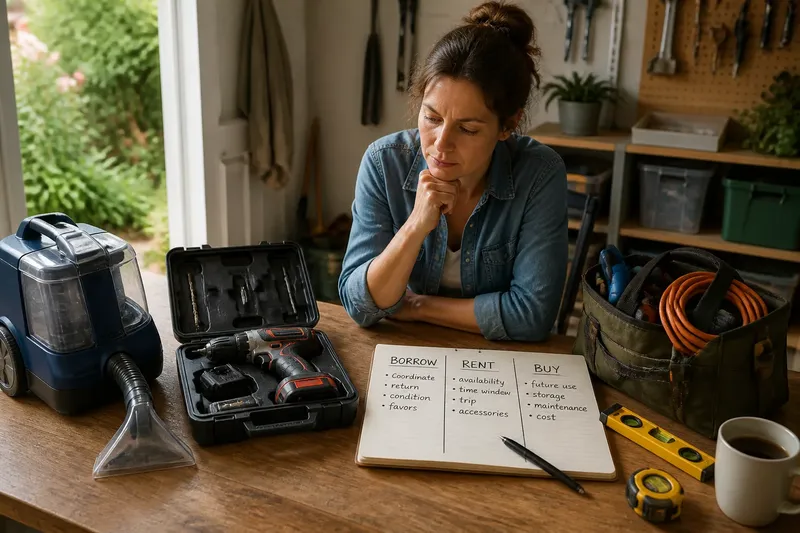
You need a stud finder for one shelf, or a carpet cleaner for a stubborn patch, and the job is waiting while the tool is not. Borrow, rent or buy a tool for one job? The best choice depends less on the tool’s sticker price than on when you can get it, where it will go afterward, and how likely you are to need it again.
For a household task, access is part of the tool. A borrowed item may be free but unavailable until a neighbor returns; a rental may be ready at a set time but require a trip; a purchase gives you control while adding another object to store. Compare the whole arrangement, not just the object.
What does each option ask of you?
Borrowing trades money for coordination. You may need to ask someone, fit their schedule, collect the tool, learn its quirks, and return it in good condition. It can be an easy choice when you already know a nearby person who owns the right model and is comfortable lending it.
Renting trades a fee and a little administration for temporary access. A hardware store or tool library may have the equipment, but you will need to check availability, collection and return times, included accessories, and the condition in which it must come back. It suits tools that are costly to keep, awkward to store, or useful for a bounded job.
Buying trades more money and space now for control later. You can choose when to work, pause midway, and keep the tool for another task. That freedom matters most when future use is plausible and storage is not an afterthought; a seldom-used tool left in a damp shed or buried behind boxes may be less useful than its ownership suggests.
There is no universally best option. A quick, simple job may favor borrowing from a trusted neighbor, while a specialized machine may make renting more sensible. Buying can fit a tool with a likely place in your household routine, especially if it is straightforward to maintain and store.
How should you compare the real costs?
Start with the job rather than the tool category. Write down what the task must accomplish, what surface or material is involved, and any feature that is essential. A drill with the wrong bit, for instance, is not a useful bargain; a carpet cleaner without the needed attachment may leave you arranging a second trip.
Then compare the full effort attached to each route:
- Access: Can you get the tool when the work area is ready, or does another person’s schedule control the start?
- Setup: Are the required bits, blades, hoses, batteries or instructions included and usable?
- Travel: Can you carry it home, and does collection or return require a separate trip?
- Time pressure: Must the task fit a narrow rental window, or can you work in short sessions?
- Storage: Is there a dry, reachable place for the tool and its accessories afterward?
- Repeat use: Is another specific task likely, or is “I might use it someday” doing all the work?
- Coordination: Who is responsible for checking it, returning it, and resolving a missing or damaged part?
These questions reveal costs that do not appear on a receipt. A borrowed tool can involve favors and follow-up; a rental can constrain your working time; a purchase can consume shelf space and leave maintenance to you. Those costs matter differently to different households, so treat them as real without pretending they can all be reduced to a precise number.
When is borrowing the easiest fit?
Borrowing tends to work well when the tool is familiar, the lender is nearby, and both sides can agree on a relaxed return arrangement. It is especially useful for a one-off task that does not require a specialist setup or a long, uncertain work session. A neighbor’s ladder for changing a reachable light bulb is a different commitment from borrowing a heavy floor sander for a weekend.
Before asking, identify the exact tool and attachments you need. Ask when it is available, how it is normally used, whether it has a case or manual, and how the owner would like it returned. A clear agreement protects the relationship as well as the equipment; borrowing should not turn into a guessing game about who is responsible for a missing accessory.
Borrowing is less attractive if the job could run long, the tool is delicate, or you are unsure how to use it. A lender may depend on having it back, and you may feel pressed to work faster than is sensible. If access hinges on repeated favors or an awkward handoff, a rental may be the calmer choice.
When does renting make more sense?
Renting suits equipment that solves a narrow problem but would be bulky, expensive, or inconvenient to keep. A carpet cleaner, tile cutter, or garden shredder can occupy substantial space between jobs. Temporary access lets you use a purpose-built tool without deciding that it belongs in your home indefinitely.
Its main trade-off is the clock. Check the opening hours, reservation rules, return condition, included accessories, and what happens if the task takes longer than expected. If you need to stop and resume over several days, a short rental window may create more pressure than the fee alone suggests.
Also consider transport and readiness. A large tool may require a suitable vehicle, another person to help carry it, or a clear route through the house. If those arrangements are difficult, ask whether a nearby tool library or rental counter offers a more convenient pickup; the closest option is not necessarily the easiest if it lacks the right equipment.
When is buying worth the space?
Buying is most persuasive when you can name a credible next use, not merely imagine an unlimited number of possibilities. A cordless drill may serve a household that regularly hangs shelves and assembles furniture; a specialized drain camera may remain unused after one diagnosis. The distinction is not how useful a tool sounds in general, but whether it fits the work you actually expect to do.
Storage is part of ownership. Consider whether the tool needs a dry cabinet, a dedicated case, charging access, or room for attachments. If it will be difficult to find, keep clean, or maintain, its availability may be more theoretical than practical.
Buying can also be reasonable when borrowing and renting are both unreliable for a task that may need several sessions. Before choosing, compare the tool’s capabilities with the job and check the maker’s instructions for suitable materials, maintenance, and compatible accessories. Those details should shape the purchase, rather than an appealing feature that the task does not need.
Which questions settle the choice?
What if I am not sure how long the job will take?
Favor an option that allows pauses without creating friction. Borrowing with the owner’s agreement or buying a tool you expect to keep can offer more flexibility than a tightly timed rental, but a rental may still work if its terms allow a longer window.
Should I buy a tool because I might need it again?
Look for a specific likely use and a sensible storage place before treating future use as a reason to buy. If the next task is vague, borrowing or renting keeps the decision open without adding an item to your home.
What should I ask before borrowing?
Confirm the tool is suitable for your task, what accessories come with it, when you can collect it, and when the owner needs it returned. Ask how they prefer it to be handled and returned, particularly if it has a case, removable parts, or a battery.
What should I check before renting?
Confirm availability, collection and return times, included parts, transport needs, and the condition expected at return. If the task depends on a particular surface or material, make sure the selected tool is intended for that use.
How can you make the decision without overthinking it?
Use a short sequence, and stop when one option clearly fits the job:
- Define the task: Name the material, result, and essential tool features.
- Check access: Ask a likely lender or rental provider whether the right tool is available when you can work.
- Test the schedule: Decide whether the job can fit a return deadline or needs room for pauses.
- Look beyond the handoff: Include transport, setup, accessories, cleanup, and return responsibilities.
- Picture the tool afterward: Identify where it will live if you buy it, and whether that place is practical.
- Choose for likely reuse: Buy when a concrete next use supports ownership; otherwise, prefer temporary access if it is convenient.
Say you need a carpet cleaner for one stained room, have no dry storage for a machine, and can set aside a full afternoon. If a nearby rental counter has the right attachment and a return window that suits your schedule, renting may be simpler than asking a friend to lend a bulky cleaner or buying one with no planned next use. If the room cannot be cleared in time, that same rental arrangement may stop fitting; the choice changes when the job’s timing changes.
What should the decision leave behind?
Whichever route you choose, make the end of the arrangement clear before the work begins. For a loan, agree on return and report any problem promptly; for a rental, keep the accessories together and plan the return trip; for a purchase, give the tool a home where you can find it and follow the maker’s care directions.
The useful question is not simply whether you will own the tool after this task. It is whether the whole arrangement—access, timing, storage, and responsibility—fits the way your household works. That is the practical measure behind borrow, rent or buy a tool for one job.