How to Store Spare Buttons So You Can Find the Right One
Spare button storage keeps each match identifiable and ready for mending, so you can find the right fastener without sorting through an unknown pile.
A spare button falls out of a paper packet and disappears among the sewing supplies just when a shirt needs mending. Spare button storage works best when it preserves not only the button, but also the information that identifies its garment.
What information makes a spare button useful?
Buttons that look alike may differ in thickness, finish, or hole pattern. A note linking a spare to its garment lets you compare the right pieces instead of relying on a vague memory or choosing a near match.
Keep the original tag or packet when it identifies the garment clearly. If it does not, add a short description specific enough to distinguish the item, such as “blue cotton shirt, shell buttons.” Avoid assigning a button to a garment based only on color.
Where should you keep matched buttons?
Choose a place that protects small pieces and fits the way household repairs are handled. A labeled paper envelope inside a sewing box works for many households; a divided case can help if its compartments are marked and remain closed. A loose button in a pocket is easy to associate with a coat, but it may be lost when the pocket is emptied or the garment is washed.
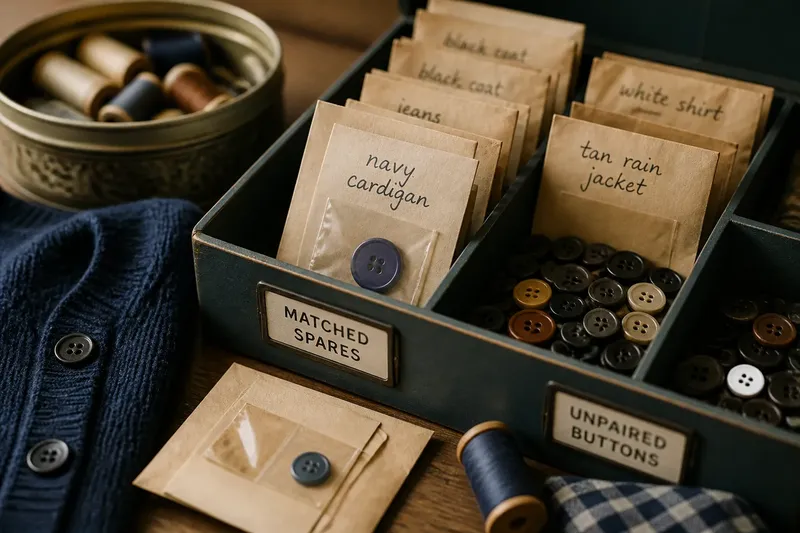
Keep matched spares apart from buttons whose source is unknown. The distinction matters: an identified spare is a direct repair option, while an unpaired button is only a possible match. A small envelope marked with the garment’s name preserves that distinction without requiring a detailed inventory.
What should you check before choosing a storage place?
- Is the button linked to a garment? If the packet or tag names the item, keep that information with it; if not, add a precise written description or place it among unidentified buttons.
- Could the storage spot be emptied or washed? If a pocket is likely to be cleared or laundered, move the spare to a sewing box; if the pocket is a dependable temporary home, retain it only while the garment is in active use.
- Will the container stay closed? If a paper packet or case can open in a drawer, put it inside a lidded box; if it stays secure, keep using it rather than transferring the button unnecessarily.
- Can another household member understand the label? If the description distinguishes the garment, leave it as written; if several items could fit it, add a color, fabric, or garment type.
- Is the button still a plausible repair match? If it is intact and belongs to a garment still kept, retain it with its identification; if the garment is gone or the button is damaged, decide whether it has a likely use elsewhere or let it go.
- Does the general button supply contain known matches? If it does, return each identified spare to its labeled packet; if a button has no reliable match, keep it in a separate unpaired section or release it.
How do envelopes, cases, and tins differ?
A paper envelope is easy to write on and keeps a garment’s label beside its button, but it can tear or open. A lidded tin protects packets from being scattered, though it is less useful if several envelopes are left unlabeled inside. A compartment case makes loose buttons visible, but the compartments need labels if matched and unpaired buttons share the case.
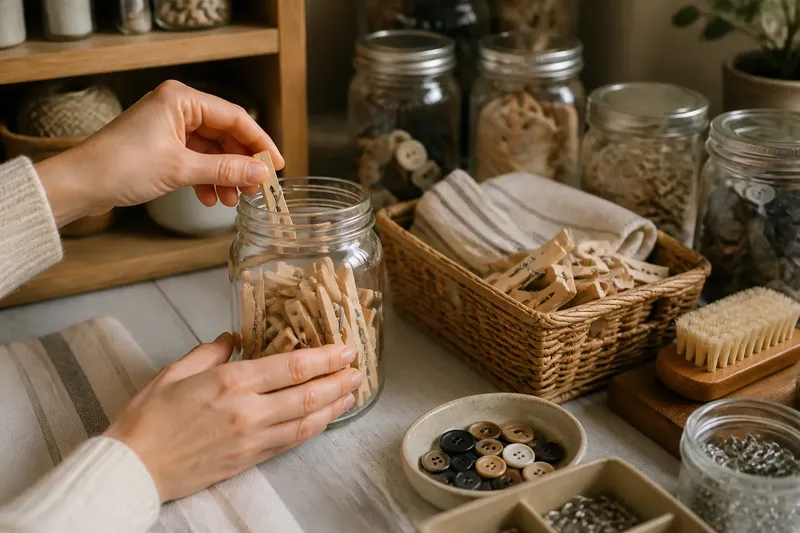
Choose the simplest container that answers two questions: which garment does this button belong to, and where can someone find it? A jar can hold unpaired buttons, but it does not identify their sources by itself. For a matched spare, use an envelope or a marked compartment rather than relying on the container alone.
What questions do people ask about spare button storage?
Should a spare button stay with the garment?
Keep it with the garment if its location is secure and unlikely to be emptied or washed. Otherwise, store it in a labeled envelope with the sewing supplies and note the garment’s identity.
What if the garment tag is missing?
Write a description that distinguishes the item, such as “tan rain jacket with dark horn-look buttons.” If you cannot identify the garment confidently, mark the button as unpaired rather than recording a guess.
Are loose buttons worth keeping?
Keep an unpaired button if it is intact and has a plausible use for a garment you own or mend. If it has no likely match and adds to a pile no one can search, letting it go may be more useful than storing it indefinitely.
Should a spare go with a donated garment?
If the spare is clearly matched and can be passed along in a labeled packet, keeping it with the garment gives the recipient useful context. If the button is loose or its source is uncertain, do not present it as a match.
What does a complete storage decision look like?
Imagine a household has a newly purchased navy cardigan, its small spare-button packet, and a sewing box with an envelope section. First, someone checks that the packet came with the cardigan and that the spare is intact. They write “navy cardigan” on an envelope, put the packet inside, and place it in the labeled section of the sewing box. The result is a button that remains identifiable and easy to retrieve; the tradeoff is that it is stored away from the cardigan, so the envelope’s description and the agreed storage location need to remain clear.
When should you stop keeping a spare?
Reconsider a spare when its garment leaves the household, the button is damaged, or the description no longer points to a likely use. An unusual, intact button may suit another garment, but keep that possibility separate from a known match rather than silently relabeling it.
For a garment being passed on, include its spare when the connection is clear and the recipient can use it. For the rest, keep matched packets identified, separate uncertain pieces, and let go of buttons that no longer have a useful purpose. That is the practical aim of spare button storage: a repair supply whose identity is still clear when a repair is needed.